Colonia 3, or the Third Colony (Tercera), was founded in the Coronel Suárez Partido (Section) in Buenos Aires Province on 11 May 1887 and is known today as Pueblo Santa María. It was originally named Kamenka by the first settlers, many of whom originated from that colony in Russia.
Santa María was founded by 24 men and their families:
Johann (Juan) Reser
Johann (Juan) Graff
Joseph (José) Meier
Joseph (José) Schneider
Jakob (Jacobo) Fogel
Joseph (José) Schroh
Joseph (José) Streitenberger
Friedrich (Federico) Streitenberger
Joseph (José) Meier, Jr.
Joseph (José) Schneider, Jr.
Michael (Miguel) Schneider
Johann (Juan) Schneider
Johann (Juan) Dailoff
Nikolaus (Nicolás) Walter
Joseph (José) Schmidt
Jakob (Jacobo) Schwindt
Anton (Antonio) Schwindt
Michael (Miguel) Siebenhaar
Johann (Juan) Maier
Nikolaus (Nicolás) Hasper
Gottlieb Schneider
Jakob (Jacobo) Schermer
Johann (Juan) Schwindt
Georg (Jorge) Streitenberger (unmarried)
The original settlers of Santa María were Roman Catholic. A wooden chapel was constructed in 1888 in the place where the settlers had erected a cross when they first arrived the year before. In the first years, Father Luis Servert from Colony Hinojo came regularly to Santa María to take care of the parishners there. From 1890 to 1896, Lazarist priests served the parish.
On 1 August 1897, missionary priests affiliated with the Order of the Devine Word came to serve the parish, sent by Reverend Arnoldo Jannsen. The first missionaries were Father Enrique Eichleitner and Father Antonio Ernest.
The corner stone for a new church building was laid later in 1897, and on 8 September 1898 the "Iglesia Natividad de María Santísima" (Church of the Nativity of the Blessed Virgin) was consecrated by Monsignor Juan Terrero Escalada, the first Bishop of La Plata. A majestic altar and two side altars were installed.
The most recent extension to the facility was completed in the 1950s by artist Salvador Schneider.
Melchior, Julius Cesar. History of the Germans of Volga.
- Spanish web site for Santa María
- Santa María (Wikipedia) - in Spanish
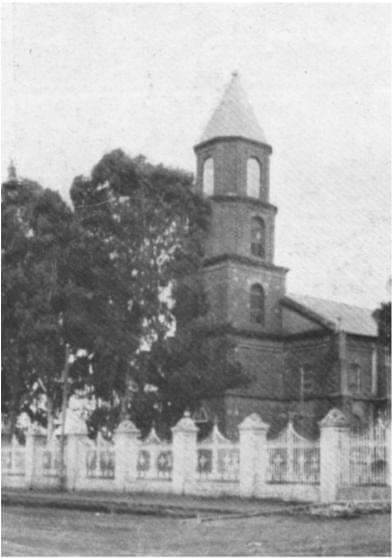
Second Catholic Church built in Santa María in 1897-1898.
Source: Jorgelina Fischer.
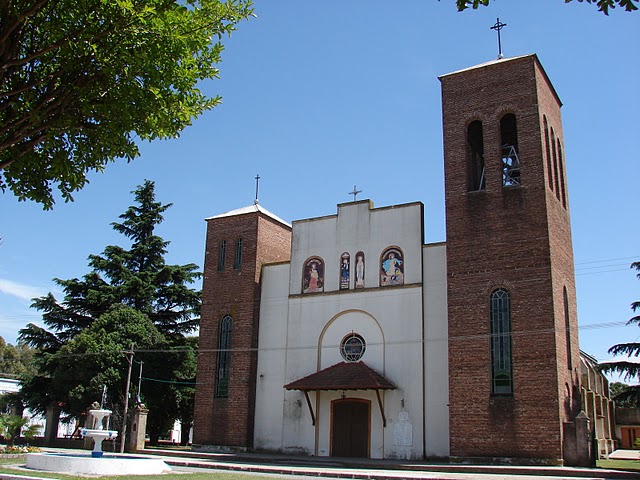
Catholic church in Santa María (2008).
Source: Unser Leit Volga.
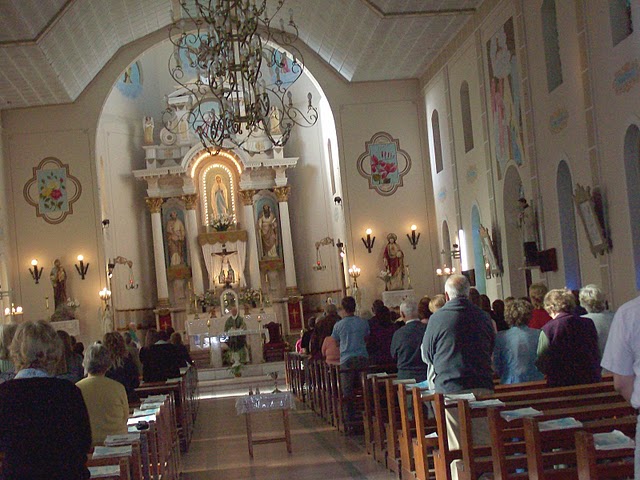
Catholic church in Santa María (2008).
Source: Unser Leit Volga.

Street scene is Santa María (2008).
Source: Gerardo Waimann.

During the terrible drought and devastating famine of 1961-1962 in the Volga German zone, the village of Santa María made a promise of a chapel to the Virgin Mary if she would bring much needed rain.

Written on the plaque in the chapel: "We shall carry the torch of the faith in God, the progress of the culture and the love to the work passed on by our ancestors - The Volga Germans - Young people of the zone - 2/12/1978"
Photos and translation courtesy of Gerardo Waimann.