By the early 1900s Volga Germans from the Russian colonies Frank, Dietel, Dreispitz, Erlenbach, Kautz, Merkel, Oberdorf, Pobochnaya, Rosenberg, Shcherbakovka, and Walter settled in Fort Collins.
With the constrution of a sugar refinery in 1903, Fort Collins became another Northern Colorado link between the sugarbeet industry and Volga Germans. The Fort Collins Colorado Sugar Company brought forty-eight Volga German families to Fort Collins in April 1903.
A tent city was constructed for them when they first arrived. The neighborhoods of Buckingham and Andersonville, built quite literally in the shadow of the sugar factory east of town, were largely inhabited by Volga German immigrants and their families. The Volga Germans called this area "Saratow" or sometimes "St. Petersburg." The press referred to the neighborhoods as "Russianville," "New Russia," "Russian Quarters," "Little Russia," and "Russiatown."
The Board of Home Missions of the German Evangelical Church Assembly of German Congregationalists established an academy in Fort Collins in 1914 to train ministers. However, after two or three years, the academy closed.
American Lutheran Church
Bethlehem Lutheran Church
Christ Congregational Church
German Congregational Church
Immanuel Christian Reformed Church
Plymouth Congregational Church
Shepherd of the Hills Lutheran Church
Trinity Lutheran Church
- Sallet, Richard. Russian-German Settlement in the United States (Fargo, ND: North Dakota Institute for Regional Studies, 1974): 50.
- Thomas, Adam. "Work Renders Life Sweet." Fort Collins Advance Planning Department, August 2003. [Online]
- Tripp, Harley. History of the RMC.
- USA Settlement List (Patricia Miller)
Fort Collins, Colorado (Wikipedia)
Colonies

Great Western Sugar Beet Factory in Fort Collins, Colorado.
Source: CSU Libraries Archives & Special Collections.
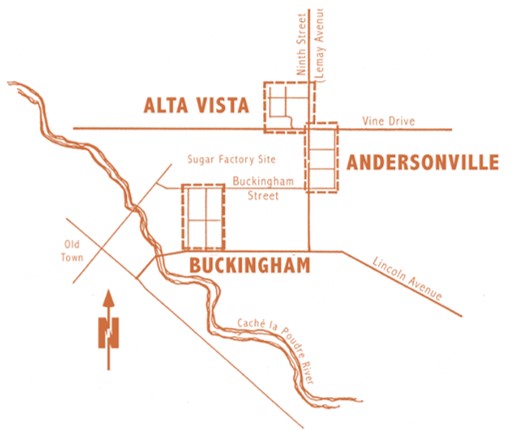
Area east of Fort Collins showing the neighborhoods of Andersonville & Buckingham surrounding the sugar factory.
Source: Adam Thomas.